
#️⃣ #Higher #Gas #Prices #Hitting #LowerIncome #Americans #Hardest
#USA #news
Higher Gas Prices Are Hitting Lower-Income Americans the Hardest
📅 2026-05-06 19:52:00 | ✍️ Talmon Joseph Smith | 🌐 NYT > Top Stories
learn about Higher Gas Prices Are Hitting Lower-Income Americans the Hardest؟
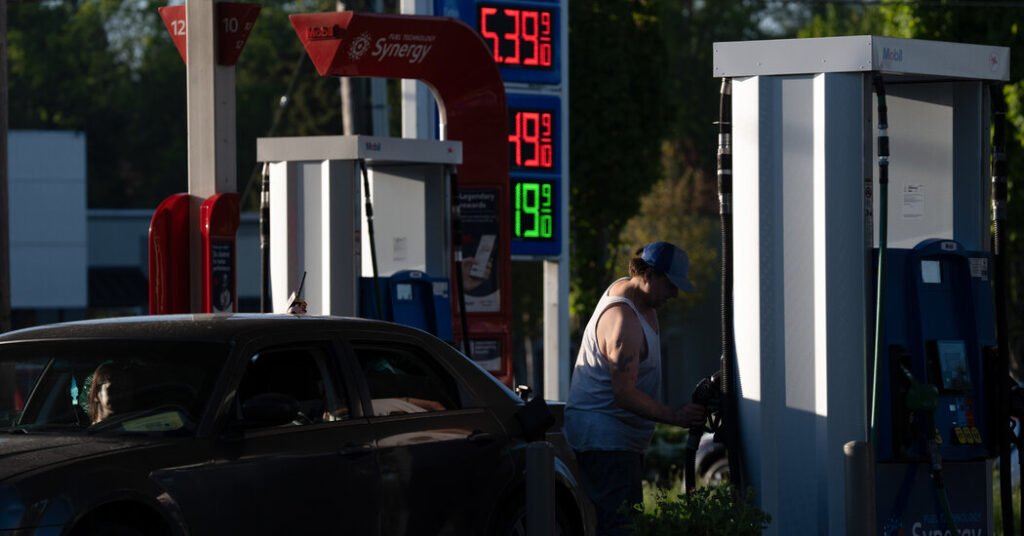
Surging gas prices are inflaming a longstanding economic divide in America, as households with lower incomes struggle to pay more at the pump at a moment when prices are already elevated.
After more than two months of war in the Middle East, the national average gas price has surpassed $4.50 a gallon. And according to an analysis released by the Federal Reserve Bank of New York on Wednesday, the burden of the surge is falling hardest on those with the least room to absorb it.
Economists at the New York Fed found that higher-income people increased spending on gasoline the most in March, but the amount of gas they bought when adjusted for inflation was “essentially unchanged,” a sign that their behavior has been largely unaffected by the fuel price surge.
Lower-income households, however, spent much more on gas than usual but cut back on the amount of gasoline they bought by driving less or “potentially by car-pooling or substituting to public transit where available,” according to the report.
The report’s title, “A K‑Shaped Pattern at the Pump,” refers to what economists have broadly been calling the “K-shaped” state of economy, in which higher-income households thrive and drive economic growth while those at the bottom slide in comparison.
Iran’s retaliatory closure of the Strait of Hormuz, a key energy channel, has sent oil prices soaring more than 50 percent from prewar levels. Oil prices fell more than 6 percent early Wednesday after President Trump pressed Iran to agree to a deal to end the war.
But oil market prices have been subject to these headline-driven gyrations for weeks and remain well above their levels near $60 a barrel in mid-February, before the war. Fears of a global petroleum shortage are still alive among oil analysts. And while investors and officials in Washington weigh the course of the conflict overseas, rank-and-file workers and commuters across the country are left managing the repercussions.
Danielle Sollers, 44, works as a driver in Charleston, S.C., putting in eight- or nine-hour shifts for Uber and Lyft. Gas prices have surged above $4 a gallon in her area, upending her already-tight budget.
“I was paying well below $3 a gallon, damn near almost $2, then it felt like, within a week or so, it spiked,” Ms. Sollers said.
Ms. Sollers drives a Kia sedan, specifically because of the above-average miles per gallon it provides. But the roughly 60 percent jump — from paying about $25 per fill-up to $40 or more — has eroded her take-home pay, especially on slower weekdays with fewer riders.
“It’s rough,” she said. “Now, you’re only making 100 to 160 bucks a day.”
The jolt in the oil market has also caused the price of other forms of fuel and petroleum-dependent products to rise: diesel, jet fuel, fertilizer and plastics. Airfares have steeply risen in recent weeks. Food inflation is also expected to tick up once the costs of fertilizer and energy-intensive packaging and transportation filter through.
The New York Fed’s analysis noted that the K-shaped gasoline consumption patterns “qualitatively match” the unequal trend that occurred after the spike in energy prices at the start of the Russia-Ukraine war in 2022, the last time gasoline and crude oil prices were this elevated. Russia’s invasion of Ukraine wreaked global havoc in commodity markets. The ensuing supply chain chaos caused elevated inflation at the time to surge even higher.
Gbenga Ajilore, the chief economist at the Center on Budget and Policy Priorities, who served as an economic development official during the Biden administration, said the pain consumers felt at the gas pump in 2022 and the pressure facing them now stemmed from different root causes.
“The Biden administration didn’t make Russia invade Ukraine,” Mr. Ajilore said.
Domestic blowback from the Trump administration’s attacks in Iran is, in Mr. Ajilore’s view, more of a self-created conundrum, “an own goal,” he said.
Economists at Nationwide, a financial firm, expect the inflation rate to peak sometime this summer at around 4.5 percent, more than double the Federal Reserve’s 2 percent target. And because the main measure of economic growth — gross domestic product — is adjusted for inflation, rising fuel costs are expected to weigh on overall growth in the coming months.
Most forecasters still expect the U.S. economy to avoid recession this year. Yet a divergence in wage gains over the past year is worsening the country’s internal financial divides, and may be part of why consumer sentiment among the bottom third of income earners has been so sour. Researchers at Bank of America noted in April that higher‑income households had experienced wage growth of 5.6 percent annually, compared with 1 percent to 2 percent growth for lower‑ and middle‑income households — the widest gap since 2015.
A substantial factor in the U.S. economy’s powering past the global commodity shock in 2022 was the underlying strength of the labor market. Wage growth among rank-and-file workers was so strong that the Fed was actively trying to tamp it down by slowing the economy. Hundreds of thousands of jobs were being added on average every month, driving up overall household income.
Even though unemployment remains low, the current employment situation stands in stark contrast to 2022, with wage growth substantially weaker and hiring at a pace more analogous to the jobs market that followed the Great Recession. The bottom 50 percent of wage earners are more vulnerable to a shock.
Research from Barclays, an investment bank, noted that demand for gasoline had become subdued in recent weeks, a signal that households may be avoiding lengthier drives or discretionary trips, even as peak summer driving season approaches.
The Federal Reserve Bank of Dallas projects that if the Strait of Hormuz remains closed through September, the cost of a barrel of crude could top $167, translating to at least $5 a gallon and levels of energy inflation that could threaten a recession.
Tay Parra, 19, works as a gas station attendant in Midland, Texas. He says that although high energy prices have been good for the oil industry in the area, his usual customers are already feeling the pinch from higher gas prices, even though it has not been as severe as on the West Coast.
“It’s starting to hit this past week or so,” Mr. Parra said. “I would say it’s cutting down on weekend trips mostly — people are not going out as much as they used to. It’s just mostly work, work, work, work, or to go see their family, and that’s probably about it.”
all what you need to know about Higher Gas Prices Are Hitting Lower-Income Americans the Hardest
🔍read more here :
USA news and travel
📌